Lobbying and lobbyists play a crucial role in our political system. Unfortunately, that role can lead to governmental intervention in our “free-market” economy. Too often this creates a scenario where the best connected are given special loopholes - be it through credits, exclusions, rebates, deferrals, or other special tax treatments – or what we call cronyism. Our thoughts on this were recently illustrated in an article published in the Clarion Ledger on January 8, 2012.
January 11, 2012
October 10, 2011
August 17, 2011
Currency Crisis
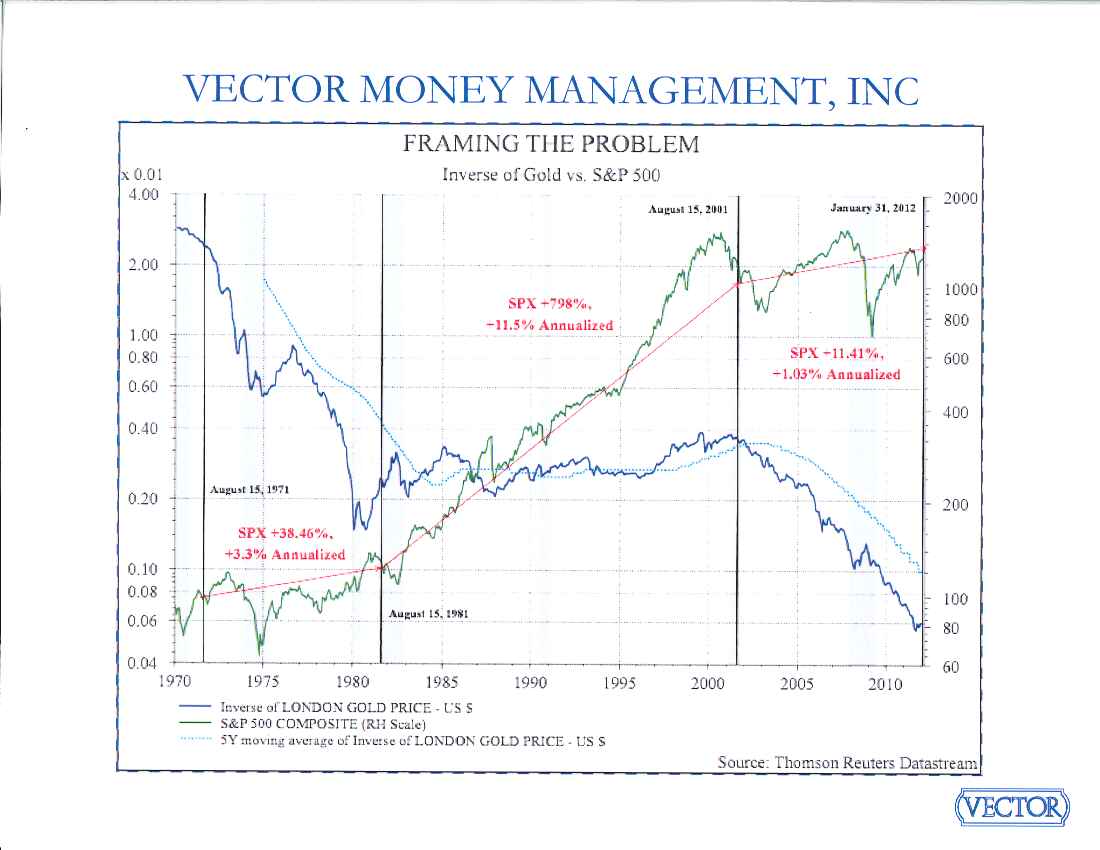
It seems obvious to us that some part of the world’s ongoing financial and economic problems are due to the use (and abuse) of fiat currencies. Our thoughts were highlighted in an article published in the Clarion Ledger on August 14, 2011.
July 20, 2011
The Red-Tape Economy
Congressional legislation aimed at regulation of certain industries can and does have unintended destructive consequences on the economy – whether we’re talking about an economy seemingly running efficiently or one trying to recover. Our thoughts on this subject were highlighted in an article published in the Clarion Ledger on July 17, 2011.
April 5, 2011
Shake up in the Energy Arena
Innovation and the hard work of wildcatters is beginning to pay big dividends for consumers of natural gas as vast new streams of gas come on market dropping prices below $5 per mcf. The ramifications for the normally staid utility industry and electricity rates are huge. Our thoughts on this issue are covered in the commentary “US Gas Bonanza” which was published in the Clarion Ledger on 3 April 2011.
November 30, 2010
Tax Rate Implications
The most important economic issue for the remainder of 2010 is the fiscal question regarding what tax rates will be in 2011 and 2012. Tax rates figure prominently into personal and business planning, and the fact that the issue is still unresolved with December upon us only adds to the economic uncertainty. Our thoughts on this vital issue appeared in an article we wrote for The Clarion Ledger, a Jackson, MS newspaper, on November 28th, 2010, and which has been posted on RealClearMarkets.com.
September 8, 2010
Mid-September Outlook and Portfolio Design
As mentioned in our August outlook (see post below), the economy and financial markets continue to struggle with what we call irregular conditions. One consequence of such conditions that is proving both problematic and annoying for investors is the lack of any return on traditional savings vehicles such as Treasury bills, CDs and money market funds. As the rates on these instruments drop below the 1% threshold, they begin to act more and more as virtual mayonnaise jars. Savings and savers have always been a vital and integral part of America’s system of capitalism. That they should now receive next to nothing for their participation is a sure sign of dysfunction in the system. It should, then, be no surprise that citizens are grumbling, the economy is sputtering and that uncertainty reigns.
As you may recall, a key economic mantra of the ‘80s and ‘90s was that government deficits would push interest rates up – now that logic has been thoroughly discredited by next-to-nothing rates coinciding with all time high government spending and borrowing.
This paradox of almost “no-cost” money and a lethargic economy is stark evidence of the complexity of the national and global economies and the myriad interdependencies therein that create unforeseen challenges and problems when policy makers meddle as boldly in the financial system as they have over the past several years.
What is today’s reality? That the Federal Reserve’s primary concern is a further drop in commercial and residential real estate prices – assets that represent trillions of dollars in collateral on bank balance sheets. Their first priority has become preventing another downturn in real estate prices. The empty return for savers is a discouraging side effect.
While the Fed may be able to offer “no cost” money to banks that qualify, there is still no free lunch. History shows that the usual result of predicaments such as this is inflation. Savers beware.
Ashby Foote
August 19, 2010
Mid-August Outlook and Portfolio Design
The financial markets continue to struggle with what we consider to be irregular conditions – record low interest rates, record high gold prices, record government borrowing, record government spending and a 9.5% unemployment rate. At times like these, it is crucial to understand, as best you can, the real situation and not default to a standard plan developed for more normal conditions. The real situation, as we see it, is that the U.S. economy is slowly recovering from the financial crisis of 2007-08, a crisis caused by a gross misallocation of capital into residential and commercial real estate. The reaction of government policy makers from both parties has been to focus on minimizing failure – from the largest organization to the individual home owner. The unintended consequence of their (often ad hoc) actions has been to create an unusual and unproductive policy mix (monetary, fiscal and regulatory) that is severely limiting the expansion of the economy during this recovery period. With little foreseeable change in the current predicament, we have focused our “portfolio design” process on sectors, industries and companies that stand to benefit from opportunities outside the U.S. where economic growth is much more robust.
On the Defensive Side: This is the most challenging period we can recall when it comes to preserving capital while also generating a reasonable return. There is a growing debate over whether Inflation or Deflation is a bigger risk. Both can wreak havoc on investment portfolios, so the issue is a crucial one for investors. We have focused on and studied the issue for a long time and it is our considered opinion that Inflation is the much more likely outcome of the current policy mix and, thus, rates as the more serious risk for investors. The U.S. Treasury Department and the Federal Reserve have run a weak dollar policy for almost ten years and there is no indication that they will adopt a strong dollar policy any time soon. It is no coincidence that during this weak dollar decade the Periodic Table of Elements (metal commodities) has easily outperformed the S&P 500 Index. For these reasons, our portfolio design continues to include a significant weighting in natural resource related companies. A weak dollar is a tail wind for the businesses of these companies, so they provide some hedge against the risk of rising inflation in the months and years ahead.
Continuous Assessment: The upcoming election on November 2nd could very well shake up the policy mix coming from Washington, especially in the fiscal and regulatory arenas. More certainty on the issue of future tax rates could be an important catalyst to putting some of the $2 trillion on corporate balance sheets to work in the U.S. economy. The latent potential of the American entrepreneur should not be underestimated.
If you have any questions or feedback please let us know.
Ashby Foote
July 21, 2010
“What’s Hot and What’s Not” Presentation at MTA Discovery Luncheon
On Tuesday, July 13th, I was honored to be the guest speaker at the Discovery Luncheon sponsered by the Mississippi Technology Alliance (MTA). I was asked to prepare an updated version of a presentation I had done in Novemeber of 2009, addressing various paradigm shifts and aptly titled “What’s Hot – What’s Not.” The thrust of the comments that accompanied the power-point slides was that paradigm shifts matter mightily to investors and entrepreneurs – get on the right side of one and you can make above average returns – get on the wrong side and you can lose your shirt. Hot new trends, products or services aren’t necessarily paradigm shifts themselves but can often be early indicators of paradigm shifts underway. To get a better understanding of my thinking for each slide, I’ve uploaded my ‘talking points’ for each slide here.
Ashby Foote
July 26, 2009
Primer: Cap and trade – Waxman-Markey cap and trade bill can ’sink a big chunk’ of the U.S. economy
Ashby M. Foote III
Contributing columnist, The Clarion-Ledger
You may have missed it in the blitzkrieg of legislative action the past few months, but if you intend to purchase gasoline or electricity in the years ahead, you had better burn some midnight oil on House Resolution 2454.
“The American Clean Energy and Security Act” (HR2454), also know as the Waxman-Markey cap and trade bill, passed the U.S. House of Representatives on June 26 by a vote of 219 to 212. That two House barons like Henry Waxman and Ed Markey could only muster a seven-vote margin for legislation promising clean and secure energy and a solution to global warming suggests that there must be some devilish details in its 1,300 pages. Devilish, indeed, this bill could well sink a big chunk of America’s economy into economic purgatory for some time to come.
The journey of HR 2454 began over two decades ago with the United Nations’ creation in 1988 of the Intergovernmental Panel on Climate Change. IPCC’s mission statement is straightforward: “The role of the IPCC is to assess on a comprehensive, objective, open and transparent basis the scientific, technical and socio-economic information relevant to understanding the scientific basis of risk of human-induced climate change, its potential and options for adaptation and mitigation.”
Skeptics point out the inherent bias of a government-funded mission to identify human-induced climate change. If you don’t find it, does your funding go away?
Twenty years later the IPCC has issued four assessment reports, accompanied by the more important Summary for Policymakers. Each report served to raise the ante on the alarming dangers of anthropogenic (man-made) global warming, resulting from increased concentrations of greenhouse gases.
At the heart of the IPCC’s work are computer models used to simulate global climate and weather. Any TV weatherman will tell you that predicting next week’s local weather is an iffy proposition even with the latest first-alert-Doppler-whiz-bang-Vipir radars.
The IPCC’s ever-more-confident and apocalyptic warnings rest on the near-impossible task of simulating with computers climate conditions for the whole planet and not for next week but for 50 to 100 years in the future. This, while science still struggles to explain exactly how clouds work.
World-renowned mathematician Freeman Dyson, who in his early years worked alongside Einstein and is now professor of physics at the Institute for Advanced Study at Princeton, had this to say about climate models: “The models solve the equations of fluid dynamics, and they do a very good job of describing the fluid motions of the atmosphere and the oceans. They do a very poor job of describing the clouds, the dust, the chemistry and the biology of fields and farms and forests. They do not begin to describe the real world that we live in.”
Falling in line with IPCC thinking, the primary goal of HR 2454 is significant reduction in carbon dioxide and other greenhouse gases. The proposed methodology to accomplish this is “cap and trade.” It is similar to the program instituted in the 1990s to reduce the threat of acid rain.
In that program, the culprit was sulfur dioxide emissions from 503 coal-burning plants in and around the Northeast. The “cap” refers to the aggregate limit of SO2 emissions to be allowed from the plants in the program.
The “trade” refers to the credits or allowances that each plant requires to match their SO2 output. An investment in technology that reduced SO2 emissions for one plant would allow that plant to sell its allowances to another plant.
The arrangement provides flexibility and market incentives in lowering the aggregate SO2 emissions. The program succeeded in reducing those SO2 emissions by 40 percent. Whether a successful program focused on 503 plants can scale up to one targeting tens of thousands of plants, and tens of millions of exhaust pipes is yet to proven.
The U.S. is four years behind Europe in implementing a CO2 cap and trade program and based on the European experience that may be a very good thing. Started with great fanfare in 2004, the European program to date has not reduced CO2 but has been a windfall for Europe’s utilities and other smokestack industries.
After heavy industry lobbying, the European Union scrapped plans to sell permits and instead gave them out for free. But that didn’t stop utilities across Europe from raising rates they charged to reflect the “putative costs” of those credits.
Europe’s biggest CO2 emitter, RWE, has come under fire for raising rates while also receiving $6.5 billion in carbon credits for free. Bjorn Lomborg, author of Cool It: The Skeptical Environmentalist’s Guide to Global Warming, points out that the biggest U.S. electric utilities spent over $51 million on lobbyists over the past six months. They have watched the European system unfold and they no doubt want their credits for free, too.
If some form of cap and trade becomes law, the carbon credits (a carbon credit represents one metric ton of CO2 emissions) will be on its way as a new form of global currency with a wide array of regulators and issuers and, no doubt, any number of unintended consequences.
Entrepreneurial types have been planning for this possibility for some time. The Chicago Climate Exchange has been trading carbon credits since 2003 and has over 400 corporate partners.
One of the earliest planners was the now-deceased Ken Lay of Enron fame. He got some new notoriety for a 1997 internal memo that said: “If implemented (the Kyoto Protocol) will do more to promote Enron’s business than almost any other regulatory business.”
As we dig our way out of the rubble and wreckage of last year’s financial crisis, the visage of a confident Ken Lay is not comforting. Even more disturbing is the common thread linking the best and brightest of the recently busted and bailed-out Wall Street and the best and brightest of the IPCC.
The thread is computer models seeking to simulate extraordinarily complex systems. Wall Street’s most prestigious firms watched firsthand in 1998 as the premier hedge fund, Long Term Capital, with the guidance of two Nobel Laureates, collapsed, a victim of computer simulations that failed to capture the real world. Did Wall Street lose faith in computer simulations? Far from it – within 10 years Wall Street had magnified the simulation fiasco a hundred-fold.
The Heartland Institute’s exhaustive analysis of the IPCC’s most recent report entitled “Climate Change Reconsidered” includes this critique: “Scientists working in fields characterized by complexity and uncertainty are apt to confuse the output of models – which are nothing more than a statement of how the modeler believes a part of the world works – with real-world trends and forecasts. Computer climate modelers fall into this trap, and they have been criticized for failing to notice that their models fail to replicate real world phenomena.”
Some final considerations: The climate glass may be half full. CO2 is not a pollutant in the way that we normally think of pollution.
In fact, CO2 is vital to our ecosystem and as we learned in 10th-grade Biology, CO2 is a crucial part of the photosynthesis process that turns sunlight into carbohydrates.
Even with the increase over the past 50 years CO2 still only makes up .4 percent of the atmosphere and the increase actually improves the planets potential for plant growth as greenhouses are want to do. Water vapor has a much bigger greenhouse effect but it is excluded from the models because like clouds, it is too hard to model.
Improved plant growth will make it easier to feed the planet’s 6 billion residents. Contrary to IPCC predictions, the Earth’s temperatures have been dropping since 1998.
In fact, this June was the coolest June in New York City in half a century – let those UN bureaucrats out of their cubicles and into the real world of Central Park. Many scientists think temperature swings have more to do with solar flares and sunspots than with CO2 concentrations.
Lastly: Government funding, political agendas and computer models make for a dangerous concoction; just ask Fannie Mae and Freddie Mac.
Mother Nature can take care of herself and so can the rest of us.
Failure Is A Market Necessity
Our belief that failure in a free market economy is necessary for cleansing and future growth was highlighted in an article we had published in the Clarion Ledger on October 9, 2011. This article was also posted on the RealClearMarkets.com website and can be viewed here.